Thinking about installing solar to lower your electricity bill? We'll connect you with verified government-empanelled installers in Etah, help you with the subsidy process, and provide free quotes so you can choose the best option with confidence.
Bijli bill kam karna hai? Apne ghar ke liye solar price aur subsidy estimate WhatsApp par turant paaiye.

Don't take our word for it. These four numbers tell the whole story:
*Government subsidy is for residential homes only (own house, sanctioned load up to 10 kW). Shops, offices and factories can go solar too, without subsidy, and payback is often even faster. See the business section below ›
Important: The prices, subsidy and savings shown here are illustrations only, to help you plan. Your final system size, payable amount, subsidy eligibility and net-metering approval are confirmed after a roof survey and DISCOM or PM Surya Ghar portal approval.
Etah mein apne ghar par solar lagwaiye aur bijli ke bill mein badi bachat kijiye. 3 kW rooftop solar system ki effective cost subsidy ke baad sirf ₹67,000–₹1,07,000 tak aa sakti hai. PM Surya Ghar Yojana aur Uttar Pradesh Government ki subsidy ka fayda lekar aap apna investment lagbhag 3 saal mein recover kar sakte hain. Iske baad solar system 20+ saal tak bijli banata rahega, jisse har mahine ke electricity bill mein achhi savings hoti hain. Hamari team subsidy process aur installation mein poori madad karti hai.
Quick facts: these figures assume 5.2 kWh/m²/day of local sunshine and a ₹6.5/unit DVVNL tariff, on a full system price of ₹1,75,000–₹2,15,000 before the ₹1,08,000 subsidy. DVVNL-empanelled vendors covering the Aligarh division serve the district under PM Surya Ghar.
☀ Prices verified October 2026 · Sources: MNRE benchmark & market quotes, DVVNL tariff order, Global Solar Atlas| System | Full price | Central subsidy* | UP subsidy* | Total subsidy* | You pay | Units a month | Saving a month | Payback |
|---|---|---|---|---|---|---|---|---|
| 1 kW | ₹65,000–₹80,000 | ₹30,000 | ₹15,000 | ₹45,000 | ₹20,000–₹35,000 | 117 | ₹761 | 3 yrs |
| 2 kW | ₹1,25,000–₹1,50,000 | ₹60,000 | ₹30,000 | ₹90,000 | ₹35,000–₹60,000 | 234 | ₹1,521 | 2.6 yrs |
| 3 kW | ₹1,75,000–₹2,15,000 | ₹78,000 | ₹30,000 | ₹1,08,000 | ₹67,000–₹1,07,000 | 351 | ₹2,282 | 3.2 yrs |
| 5 kW | ₹2,90,000–₹3,50,000 | ₹78,000 | ₹30,000 | ₹1,08,000 | ₹1,82,000–₹2,42,000 | 585 | ₹3,803 | 4.6 yrs |
| 10 kW | ₹5,50,000–₹6,50,000 | ₹78,000 | ₹30,000 | ₹1,08,000 | ₹4,42,000–₹5,42,000 | 1170 | ₹7,605 | 5.4 yrs |
These are typical market prices for good-quality, subsidy-eligible equipment, fitting included. Your exact quote depends on your roof and the brand you pick. Always compare 2–3 quotes before deciding. Savings are worked out at your local electricity rate (₹6.5/unit, DVVNL) and local sunshine (5.2 kWh/m²/day). *Subsidy columns apply to residential homes only.
Send us one message. We reply with verified installer options for your district and a price estimate for your bill size.
Free for homeowners. The subsidy always comes directly to your bank account.
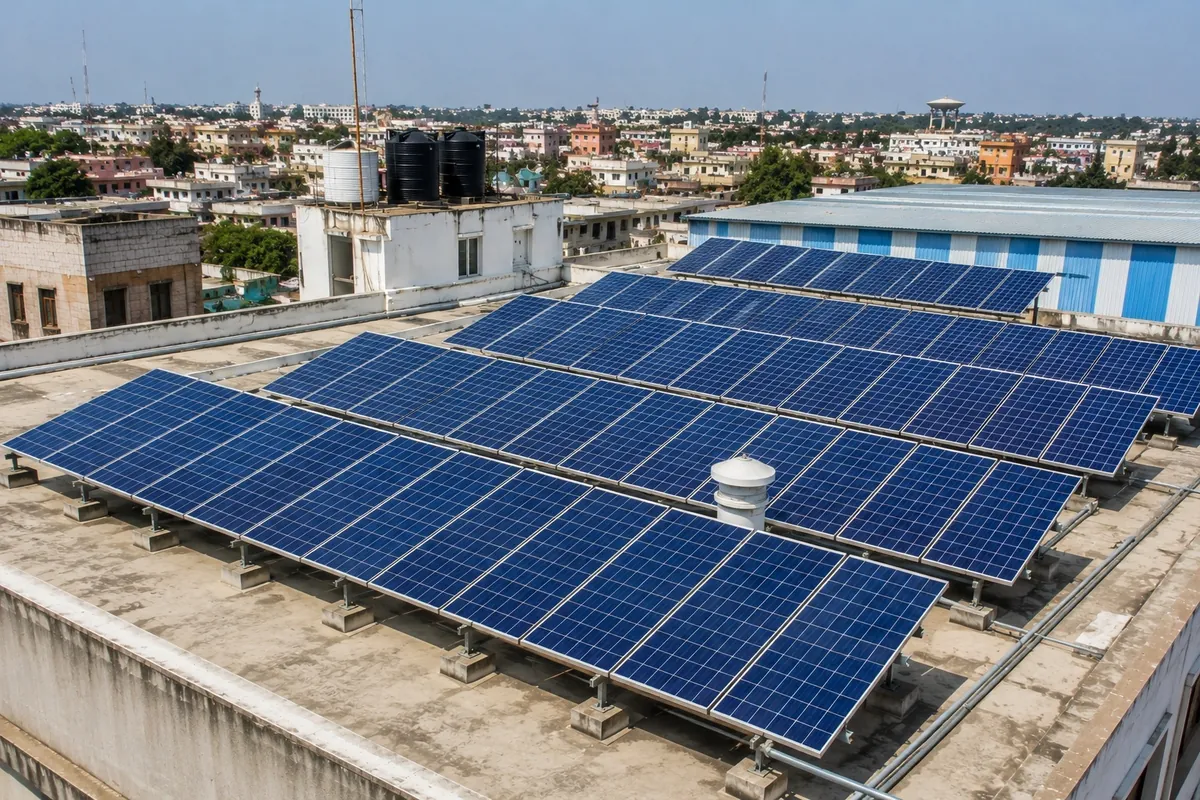
Etah sits in the Aligarh division on the doab plains between the Ganga and the Yamuna, a farming district where sugarcane, potato and mustard set the rhythm of the year. Its power network is run by DVVNL, not by Madhyanchal (MVVNL), which supplies Budaun and Bareilly further north, so feasibility approval and net metering for a PM Surya Ghar application route through Dakshinanchal offices instead. Etah city, Aliganj and the brass and bell workshops of Jalesar all draw from that same grid, and workshop owners here watch tariffs as closely as families do. Most homes across the district are single storey with open, unshaded terraces, which is exactly the roof a 3 kW system needs.
Etah district (Aligarh division) has a population of about 17,74,480 with roughly 3,10,000 households, around 15% urban. Tehsils include Etah Sadar, Aliganj, Jalesar.
The district has 3 tehsils and 853 villages in the 2011 Census. We take enquiries from every one of them, towns and villages alike.
| Tehsil | Villages | Towns (population) |
|---|---|---|
| Etah Sadar | 471 | Etah (1,18,517), Marehra (19,542), Bhagipur (12,414), Nidhauli Kalan (8,418), Sakit (8,089) |
| Aliganj | 232 | Aliganj (28,396), Jaithara (12,009), Raja Ka Rampur (11,644) |
| Jalesar | 150 | Jalesar (38,130), Awagarh (10,983) |
The biggest of the three tehsils, with more than half of the district's villages, spread around the district headquarters. The city is the trading point for the paddy, sugarcane and oilseeds grown in the surrounding villages, and it is where the district administration sits. Outside the city, Marehra is the largest town, followed by Bhagipur, Nidhauli Kalan and Sakit. A home in any of these towns or villages applies for PM Surya Ghar the same way, with the consumer number printed on its DVVNL bill.
The eastern tehsil. Aliganj town is known as the City of Plums and has an old fort, and Jaithara and Raja Ka Rampur are its two other towns. Two of its villages, Dhumari and Sarai Aghat, each had close to 10,000 people in 2011, as many as some of the district's towns. Homes here are further from the district headquarters, but that does not matter for solar: the installer's survey visit comes to your house, and the subsidy application is made online.
The south western tehsil, and the one closest to Agra, about 48 km away on NH 321G. Jalesar is famous for its brass work and cast temple bells, and those workshops are exactly the kind of small business that can go solar without the home subsidy, on commercial rates. Awagarh, the tehsil's other town, has a fort of its own. Patna Bird Sanctuary lies about 5.5 km from Jalesar and fills with migratory birds every December and January.
Electricity in Etah comes from Dakshinanchal Vidyut Vitran Nigam Limited (DVVNL). They approve your solar application, and UPNEDA is the state agency behind the scheme. Getting the subsidy takes six steps:
Uttar Pradesh adds a state subsidy of ₹15,000 per kW, capped at ₹30,000, under the UP Solar Energy Policy 2022–27, in addition to the central PM Surya Ghar subsidy. A 3 kW home therefore gets ₹78,000 central + ₹30,000 state = ₹1,08,000 total.
Full scheme details: our PM Surya Ghar subsidy guide and the Uttar Pradesh solar page.
Etah gets strong sunshine, 5.2 kWh/m²/day on average. In plain terms: every 1 kW of panels makes about 3.9 units of electricity a day, so a 3 kW system gives you around 351 units a month across the year. More in summer, a little less in the monsoon. As a bonus, one such system keeps roughly 3.5 tonnes of CO₂ out of the air every year.
Under PM Surya Ghar your subsidy is released only when the system is installed by a vendor empanelled with DVVNL. Before we share any enquiry from Etah, we check four things. And we share your enquiry with a maximum of three installers:
Compare verified installers now
Homes come first at Zsolar. But if you run a shop, office, school, hospital or factory, solar often pays back even faster, because commercial electricity rates are higher. Two things to know: the PM Surya Ghar subsidy is for homes only, so commercial systems are quoted without subsidy. And besides net metering, Uttar Pradesh also allows gross metering for systems from 1 kW up to 2 MW. Meaning a business can sell all its solar power to the grid at a fixed rate instead of using it, with yearly settlement, under UPERC rules (worth re-checking the current rate when you apply). You can own the system yourself or have a third party install and run it on your roof.
Send us a commercial enquiry through the same form. The button below opens it with "Factory / industrial" already selected; switch to "Shop / office" if that fits you better.
Check for my shop or factoryFor most homes here, a 3 kW rooftop system costs ₹67,000–₹1,07,000 after subsidy. The gross cost is ₹1,75,000–₹2,15,000, from which the ₹78,000 central PM Surya Ghar subsidy plus the ₹30,000 Uttar Pradesh state top-up is deducted. Smaller 1–2 kW systems cost less; exact pricing depends on your roof and the installer's site survey.
The central PM Surya Ghar subsidy is ₹30,000 for a 1 kW system, ₹60,000 for 2 kW, and ₹78,000 for 3 kW or larger (residential, sanctioned load up to 10 kW). Uttar Pradesh adds a state top-up of up to ₹30,000 on top of this. The subsidy is paid directly into your Aadhaar-seeded bank account after commissioning. Never to the installer or to us.
Register on pmsuryaghar.gov.in with your DVVNL consumer number, wait for feasibility approval, choose an empanelled vendor, get the system installed with ALMM-listed equipment, complete net metering, and the subsidy is credited to your bank account. End to end this typically takes 45–90 days.
No. Zsolar is a private enquiry service. We are not affiliated with MNRE, PM Surya Ghar or any government body. We connect you with DISCOM-empanelled installers in your district; the government subsidy always comes directly to your own bank account.
Output dips during overcast monsoon weeks and shortens with winter days, while summer months over-produce. The 351-units-per-month figure for a 3 kW system is an annual average across these seasons.
Yes, commercial rooftop solar works well and often pays back faster due to higher tariffs. But the PM Surya Ghar subsidy applies only to residential connections. We can still connect commercial enquiries with installers; the economics are quoted without subsidy.
Your latest electricity bill (DVVNL consumer number), Aadhaar, proof of roof ownership, a photo, and an Aadhaar-seeded bank account for the subsidy transfer. The empanelled vendor usually helps upload these on the portal.
No. The application must be in the name of the electricity connection holder who owns the property. If you rent, the owner can apply and the bill savings pass through your arrangement with them.
The district is served by Dakshinanchal Vidyut Vitran Nigam Limited (DVVNL). It matters because your feasibility approval, vendor empanelment check, net metering and final commissioning all go through DVVNL. And your installer must be empanelled with it for the subsidy to be released.
The ranges on this page were verified in October 2026 and are refreshed quarterly. Panel prices move with market and policy changes, so treat them as a benchmark for comparing quotes. Your final price comes from the installer's site survey.
We try to avoid jargon, but some official words are unavoidable. Here is what they mean in plain language:
The size or power of a solar system. Think of it like the engine size of a car. A 3 kW system is the most common home size. It needs about 300 sq ft of open roof.
What your electricity bill counts. 1 unit = running a 1,000-watt appliance for 1 hour. If your bill says 300 units, a system making 340 units a month covers all of it.
Your electricity supply company. The one that sends your bill. In UP these are MVVNL, PVVNL, PUVVNL, DVVNL and KESCO. They approve your solar application and fit the net meter.
Ministry of New and Renewable Energy. The central government ministry that runs the PM Surya Ghar solar scheme.
The UP state agency for renewable energy. It manages the state's extra solar subsidy and vendor registration in Uttar Pradesh.
An installer officially registered with the government/DISCOM. Your subsidy is released ONLY if an empanelled vendor installs your system. This is the single most important thing to check.
The government's approved list of solar panels (ALMM), made in India (DCR). Subsidy is paid only for panels on this list. If a quote looks too cheap, the panels may not qualify.
A special two-way meter. Power you use comes in; extra solar power goes out to the grid and is subtracted from your bill. You pay only the difference.
For businesses: instead of using your solar power, you sell ALL of it to the grid at a fixed rate and keep buying power normally. Allowed in UP for 1 kW to 2 MW systems.
Direct Benefit Transfer. The subsidy money goes straight from the government into your bank account. Nobody in between, including us.
The maximum power your electricity connection is approved for (printed on your bill). Your solar system cannot be bigger than this, and the scheme covers loads up to 10 kW.
A normal flat concrete roof. The ideal surface for solar panels. Tin and sloped roofs also work with special mounting frames.
Sources & verification: PM Surya Ghar portal (pmsuryaghar.gov.in) and MNRE for subsidy slabs and vendor empanelment; Dakshinanchal Vidyut Vitran Nigam Limited tariff order for the ₹6.5/unit domestic rate; Global Solar Atlas for solar radiation; Census of India 2011 for tehsil village and town counts; market quotes for equipment cost ranges. Last verified: October 2026.